Your Factory Report Is a Goldmine—Are You Ignoring It?
Are You Just Filing Away Your Monthly Maintenance Reports?
Hello, I'm Wang Jin-ho, the technical director at 'Modu-ui-Machine' ('Everyone's Machine'), where I act as the technical shield for businesses here in Seongnam, a major tech and industrial hub in South Korea. Let me ask you a question. That monthly maintenance report for your facility's equipment—what happens to it after you get it? Do you give it a quick glance, sign off, and slide it into a filing cabinet, never to be seen again? If so, you're not alone. Many business owners I meet see these reports as little more than a formal confirmation that 'nothing broke last month.' But treating it this way is like finding a map to a hidden treasure and using it as a coaster. You're missing out on critical business intelligence that is directly tied to your bottom line and future profitability. A properly executed report isn't just a record of the past; it's your most powerful weapon for predicting future breakdowns and preventing unnecessary, often catastrophic, expenses.
Here in 2026, the world of facility management has evolved far beyond simple check-ups. We're now firmly in the era of AI-powered predictive maintenance. My approach combines 25 years of hands-on, in-the-trenches experience with these cutting-edge technologies. My mission is to transform your monthly report from a simple inspection log into a strategic playbook that helps you design the future of your operations. I'm going to walk you through what a truly valuable report looks like, using a sample from my own work (with sensitive data blurred for confidentiality), and show you the secrets to a report that can save you thousands, if not tens of thousands, of dollars.
A Simple Checklist vs. a Data-Driven Diagnosis: What's on Your Desk?
On the surface, all reports might look similar—tables, checkmarks, technical jargon. But the depth and utility can be worlds apart. A report that just has a series of 'Inspection Complete' stamps is effectively useless when a real problem arises. It offers no insight, no warning, and no path to a solution. In contrast, a report from a true equipment diagnosis expert, like our team at 'Everyone's Machine,' is built on a foundation of hard data. Every single item, every recommendation, is evidence-based. I urge you to take out your latest report and see if it contains the following essential elements. If it doesn't, you're not getting the full picture.
What a World-Class Monthly Report Must Include:
Quantitative Data Analysis: Your report shouldn't just say a machine is 'Normal' or 'OK.' That's a subjective opinion. It needs objective, measurable data. We're talking about specific figures for vibration, temperature, and electrical current for each key piece of equipment. More importantly, it should track the trends over time. Instead of 'Normal,' a valuable report says something like, 'Main spindle bearing vibration has increased by 0.5mm/s since last month's baseline. While still within operational tolerance, this trend warrants closer monitoring in the next cycle.' This is the difference between a guess and an informed observation.
Cost-Saving Impact Analysis: This is where the value becomes crystal clear. A great report doesn't just list what was done; it shows you the money you saved. For example, it should quantify the 'return on investment' of your maintenance program with lines like: 'Preventive replacement of a worn-out conveyor belt averted an estimated $7,000 in emergency repair costs and 12 hours of production downtime.' Or, 'Fine-tuning the compressor system based on energy monitoring has resulted in a projected annual electricity saving of $1,200.' This data proves that proactive maintenance is not an expense—it's one of the best investments you can make.
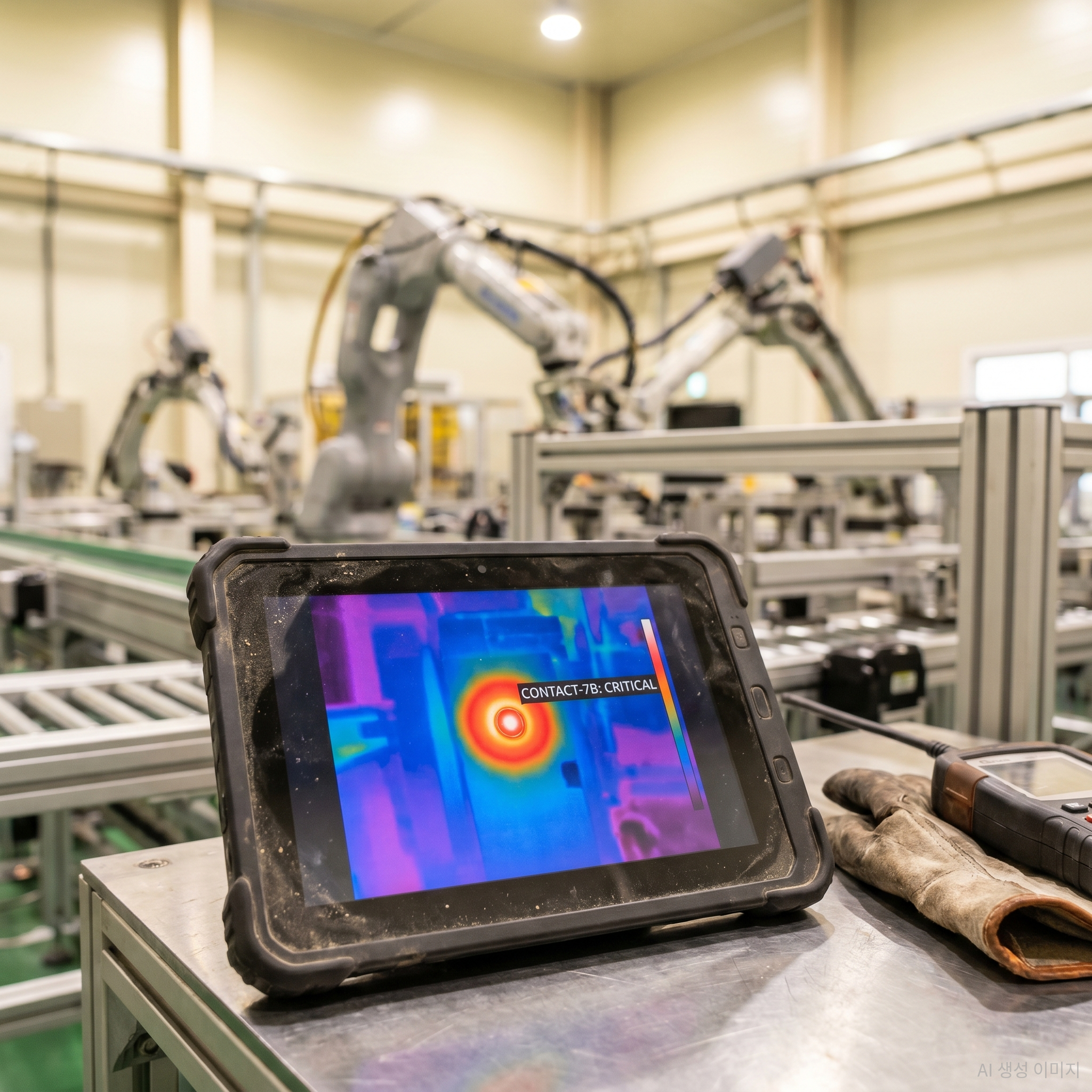
Integrated Visual Documentation: A picture is worth a thousand words, especially when you're not on the factory floor. The report should include high-resolution photos or even short video clips of potential problem areas, such as thermal imaging showing an overheating electrical contact or before-and-after photos of a critical repair. This visual evidence provides an intuitive, immediate understanding of the situation, empowering you to make faster, more confident decisions about your assets.

How We Cut a $6,000 Quote by Finding the Real Answer On-Site
I don't just talk about expertise; I demonstrate it where it matters most—on the factory floor. Let me share a real-world example of how our outsourced maintenance system works in practice and delivers tangible results. Not long ago, a pharmaceutical company in Paju, South Korea, was facing a significant issue with their automated packaging line. They had received a quote for 7 million Korean Won (approximately $6,000) to replace a servo motor that was behaving erratically. The previous maintenance provider had diagnosed the problem as simple 'motor aging' and recommended a full, costly replacement.
Sensing something wasn't quite right, the factory manager called us in for a second opinion. Instead of just looking at the motor, I brought in our precision diagnostic equipment. After a thorough analysis, the data pointed not to the motor itself, but to a microscopic contact failure within the encoder cable connecting to the motor. It was sending faulty signals, making the motor seem like it was failing. We pinpointed the source of the electrical noise, replaced the faulty cable for a few hundred dollars, and the entire system returned to perfect operation. The plant manager was ecstatic. 'Mr. Wang,' he said, 'you just saved us from throwing $6,000 down the drain.' In another case involving factory automation equipment at a plant in Ansan, a client was experiencing inconsistent marking from a high-end laser etcher. Their initial thought was a multi-thousand-dollar laser head replacement. Our diagnosis found the issue was simply a buildup of microscopic debris on the focusing lens, which we resolved with a professional cleaning and system recalibration. This is the power of accurate, data-driven diagnosis. As one of our long-term clients puts it, 'The report from Everyone's Machine isn't just a maintenance log; it's the annual health check-up for our entire factory.'
━━━━━━━━━━━━━━━━
━━━━━━━━━━━━━━━━
Common Questions from Factory Owners (and My Clear-Cut Answers)
Over the years, I've heard similar questions from hundreds of business owners. Here are a few of the most common ones, along with my straightforward answers. I'm sure many of these will resonate with you.
Q1. How can I accurately determine the right time to replace a major piece of equipment?
A. Relying solely on the manufacturer's recommended service life or the machine's age is a dangerous gamble. The only reliable way is to let the data guide you. We continuously track the equipment's vital signs—vibration signatures, thermal patterns, energy consumption, and output quality. When we detect a consistent, negative trend that indicates irreversible wear, we move to the next step. This involves a comprehensive economic analysis: we weigh the projected cost of future repairs and potential downtime against the cost of a new unit, factoring in lead times for parts and new equipment. We then present you with a clear, data-backed report outlining the optimal replacement window, so you're making a strategic financial decision, not a panicked reaction to a failure.
Q2. I have multiple quotes from different vendors. What's the most important factor in choosing one?
A. It's tempting to default to the lowest price, but this is often the most expensive mistake you can make. The single most important thing to look for in a quote is the 'diagnostic basis.' Does the proposal clearly explain the root cause of the problem with supporting evidence? Or does it offer a vague explanation like 'replacement required due to wear and tear'? A vague diagnosis is a massive red flag. Always choose the partner who can show you the data, explain *why* they are recommending a specific solution, and confidently justify their approach. The right partner sells you a solution based on expertise, not just a part or a service.
Q3. I'm worried the monthly cost of an outsourced maintenance system will be a burden. Is it really worth it?
A. This is a matter of perspective: are you viewing it as a cost or as an investment? The monthly fee for a proactive maintenance program is predictable and manageable. In contrast, the cost of a sudden, catastrophic equipment failure is unpredictable and potentially devastating. It includes not just the exorbitant cost of emergency repairs, but also lost production, missed deadlines, damaged client relationships, and team overtime. Our outsourced maintenance system is designed to be an investment in operational stability and profitability. And we don't just ask you to take our word for it—our monthly reports explicitly detail the costs we've helped you avoid, proving the value of your investment in black and white.

Is Your 'Technical Shield' Ready for Anything?
We've covered the essential components of a truly valuable 'monthly maintenance report sample' and seen through real-life examples how it can protect your business. Remember, that report should be far more than a piece of paper. It is a compass that helps you navigate potential risks, a diagnostic tool that keeps your operations healthy, and a strategic guide that illuminates the path to a more efficient and profitable future. Only a systematic management approach, grounded in objective data, can reliably prevent unnecessary expenses and guarantee the stable production you depend on.
So, I ask you again: How strong is the technical shield protecting your facility? Take a moment today to look at your last maintenance report. Is it just a checklist, or is it a powerful business partner working to secure your success?
If you're facing persistent equipment problems or are concerned about the health of your machinery, please don't try to solve it all on your own. Reach out and let a 25-year equipment diagnosis expert provide the clarity and solutions you need.
#factory #maintenance #predictive #maintenance #industrial #equipment #cost #saving #outsourced #engineering #machine #diagnostics #manufacturing #efficiency
📚 Want more perspectives on this topic? Browse related articles — curated by Google Search for authoritative external sources.


댓글
댓글 쓰기